Solar Assessment
Solar Resource • Climate • Site Layout

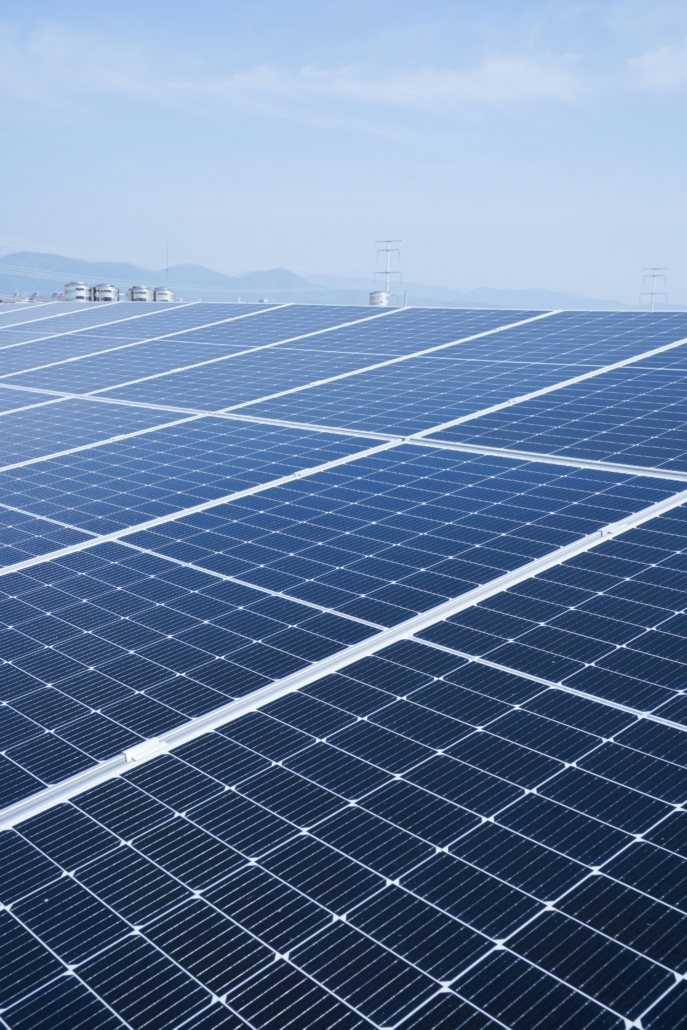
Every project begins with a comprehensive site assessment, including solar resource analysis, evaluation of geographical and climatic constraints, and identification of the optimal system layout. Feasibility studies are carried out using industry-leading software such as PVsyst, PVGIS, SolarCalc, and Geographic Information Systems (GIS) to deliver accurate and reliable performance projections.
Our teams then manage the entire administrative process, including planning permissions, grid connection applications, connection agreements, and coordination with the distribution network operator. From a technical perspective, we design both DC and AC electrical systems (MV/LV), coordinate subcontractors, supervise installation works, and oversee the commissioning of the photovoltaic plant.
The entire project is managed through comprehensive technical and financial oversight, from the initial feasibility study through to final handover.
Solar Resource • Climate • Site Layout
Permissions • Grid Connection • Enedis Coordination
DC/AC Systems • MV/LV Networks
Subcontractor Management • Construction Execution • Project Handover
From Feasibility to Project Handover
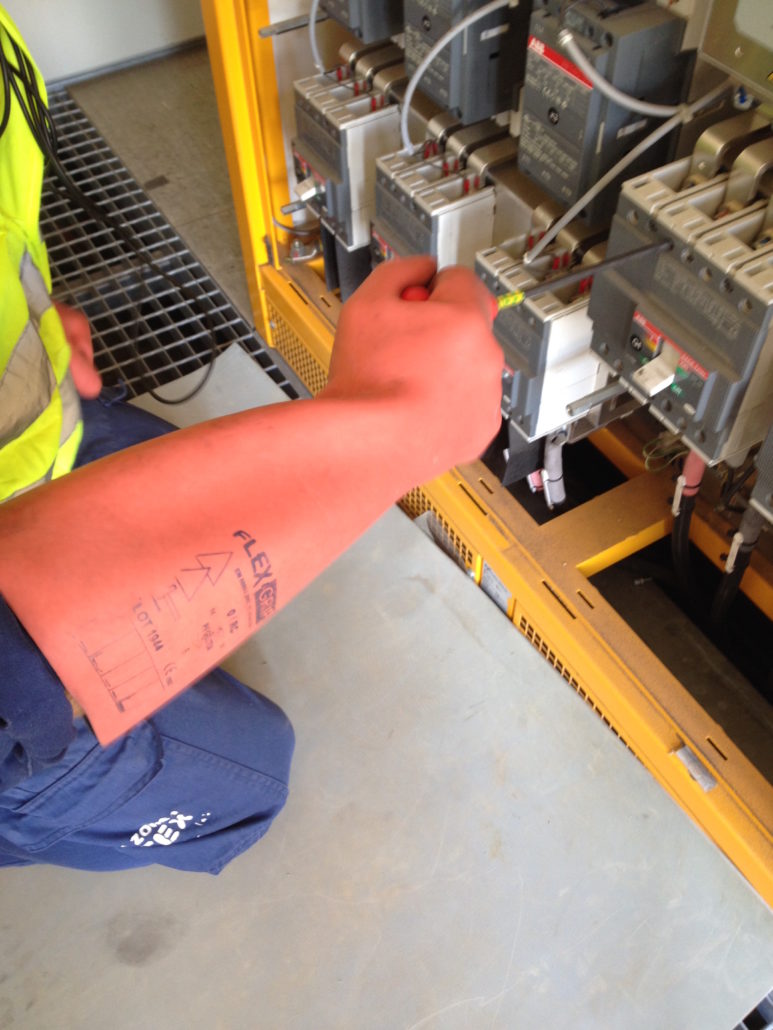
The performance of a photovoltaic installation is not measured solely by its installed capacity, but by its ability to deliver reliable long-term performance. Euroelec-Smart Energy provides preventive maintenance services based on rigorous protocols that comply with manufacturers’ recommendations and current regulatory requirements.
Our annual on-site maintenance covers all key components of the installation, including inspections of cable routing, connectors, and safety signage, inverter and transformer station checks, as well as electrical testing and IV curve measurements. We also ensure compliance with contractual obligations involving energy providers and grid operators, including EDF and Enedis, while verifying that the installation continues to meet all applicable regulations.
In addition to visual inspections and electrical testing, we carry out annual infrared thermographic surveys of rooftop installations and technical rooms. This non-invasive technology detects thermal anomalies invisible to the naked eye—such as hot spots, faulty connections, and degraded PV cells—before they impact system performance, reliability, or safety.
Comprehensive On-Site Inspection
Inverters • Cables • Connectors
Legislation & Contractual Compliance
Early Fault Detection
Our monitoring platform provides real-time performance tracking of your photovoltaic plant, including voltage, current, alarms, monthly Performance Ratio (PR), and system availability. Actual energy production is continuously compared with expected output based on PVsyst simulations and on-site solar irradiation measurements.
For existing photovoltaic installations, we also offer repowering services: targeted upgrades of key equipment to improve system efficiency and installed capacity. Each project is supported by a detailed financial assessment, a proven return on investment (ROI), and a clearly defined implementation plan.
Voltage • Current • Alarms
Monthly Performance Monitoring
Comparaison PVsyst + site
Modernization & ROI
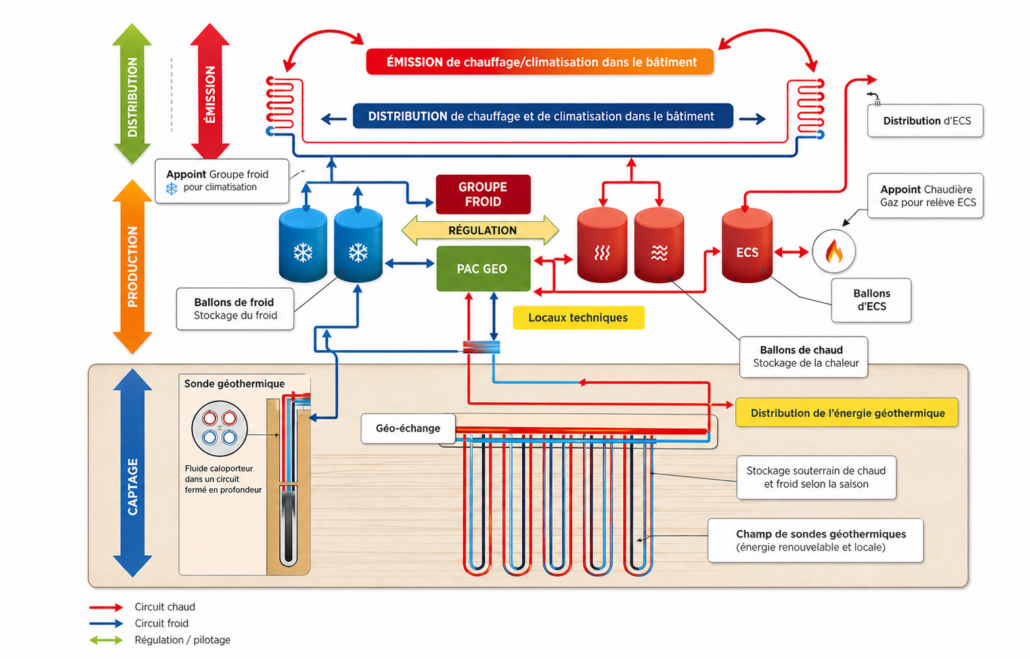
A shallow geothermal system is based on three interdependent components. The ground collector extracts geothermal energy through underground collectors—either vertical borehole heat exchangers or horizontal ground loops, depending on site conditions. The production system, powered by a ground-source heat pump (water-to-water), transfers the thermal energy extracted from the ground to the building’s distribution network for heating, domestic hot water, or cooling. Finally, the control system manages communication between these components, ensuring reliable operation and optimum performance under all operating conditions.
Together, these three components form a fully integrated geothermal system, where the performance of each element directly influences the overall efficiency of the installation. At the heart of the system is the ground-source heat pump, a thermodynamic device that generates heating or cooling by extracting or injecting thermal energy into the ground. The efficiency and long-term stability of the system largely depend on the ground collector, which determines the quality and consistency of the available geothermal resource throughout the year.
Geothermal Boreholes & Ground Collectors
Water-to-Water Ground Source Heat Pump
Control & Communication System
A ground-source heat pump can meet all of a building’s thermal requirements while delivering outstanding energy efficiency. In heating mode, it extracts thermal energy from the ground and supplies the building’s distribution network at flow temperatures ranging from 35/30°C to 55/50°C. Domestic hot water production is based on the same thermodynamic principle.
For cooling, passive geothermal cooling (geocooling) circulates the naturally cool geothermal fluid through a heat exchanger without operating the compressor. This highly efficient process can deliver between 40 and 70 kWh of cooling for every 1 kWh of electricity consumed.
Where active cooling is required, the ground-source heat pump operates in cooling mode with efficiencies ranging from 400% to 650%, using standard chilled-water temperatures from 7/12°C to 17/22°C.
The highest level of performance is achieved with Thermo-Frigo-Pump (TFP) technology. Using a single production unit, the system simultaneously provides heating and cooling by recovering and redistributing thermal energy. By combining both SCOP and SEER performance, the overall system efficiency can reach 800% to 1,200%—equivalent to delivering 8 to 12 kWh of useful thermal energy for every 1 kWh of electricity consumed.
35–55°C, PAC géothermique
Eau chaude sanitaire
Froid passif, rendement x40 à x70
Chaud + froid simultanés

Euroelec-Smart Energy is primarily involved in shallow geothermal projects during the design phase, for which we hold the OPQIBI 1007 and OPQIBI 2013 engineering certifications, as well as ten-year professional liability insurance. This phase is carried out in four stages—Preliminary Design (APS), Detailed Preliminary Design (APD), Detailed Design & Tender Documents (PRO/DCE), and Tender Assistance (ACT)—in close collaboration with the project owner.
Upstream, we also provide project programming services, including energy demand analysis, pre-feasibility studies, expertise under the French “Géothermie de Minime Importance” framework, preparation of ADEME funding applications, and regulatory submissions under the French Mining Code for installations exceeding 500 kW of thermal capacity.
During the construction phase, we rely on our RGE Qualiforage and QualiPAC certifications to deliver the works through the Execution Design (EXE), Construction Supervision (DET), and Project Acceptance (AOR) stages. Our engineering team designs the complete production and control systems, supervises construction, and coordinates the integration of the geothermal installation with HVAC, electrical (LV/ELV), and Building Management System (BMS) packages.
This end-to-end expertise—from concept design to final handover—ensures technical consistency, seamless system integration, and optimum overall performance.
OPQIBI 1007 & 2013
Qualiforage & QualiPAC RGE
Pre-Feasibility Studies • ADEME Funding Applications
CVC, CFA/CFO, GTB
A stable, discreet, and cost-effective energy solution that operates independently of weather conditions and can be integrated into virtually any type of project.
Renewable • Zero Emissions
Seamlessly Integrated into the Building
Weather Independent
24/7, 365 Days a Year
5.5% VAT • Tax Credits • Public Funding (ADEME)